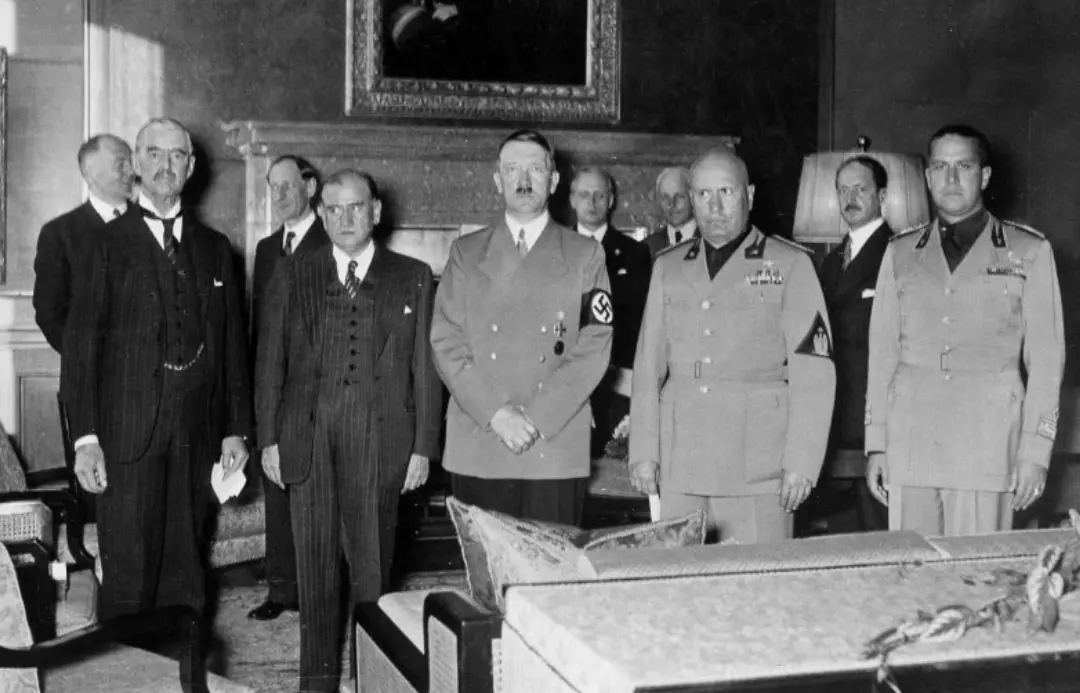
Are we sleepwalking into a historical catastrophe? As the world watches Vladimir Putin's brutal war in Ukraine, a chilling historical parallel emerges that we ignore at our peril. The demand that Ukraine surrender the Donbas region in exchange for a supposed "peace" is a terrifying echo of the 1938 Munich Agreement, a deal that paved the way for the most destructive war in human history. To understand why giving Putin what he wants is so dangerous, we must first confront the ghost of Munich.
What Was the Munich Betrayal?
In 1938, Adolf Hitler demanded that the Sudetenland, a border region of Czechoslovakia, be handed over to Germany. His pretext was the protection of ethnic Germans living there. In a desperate attempt to avoid war, British Prime Minister Neville Chamberlain and French Prime Minister Édouard Daladier met Hitler in Munich. Along with Italy's Benito Mussolini, they decided the fate of a sovereign nation without a single Czechoslovak representative in the room.
Czechoslovakia was told to either accept the annexation of its territory or resist Germany alone. Believing he had prevented a major conflict, Chamberlain returned to Britain famously waving the agreement and declaring "peace for our time." It was a catastrophic miscalculation. In Czech and Slovak history, this event is not known as an "agreement," but as the "Munich Betrayal."
The High Price of "Peace"
This policy of appeasement did not bring peace. Instead, it was a green light for aggression. Hitler saw the Western powers as weak and unwilling to fight. The Munich Agreement emboldened him, confirming his belief that he could continue his expansionist agenda without consequence.
Having sacrificed Czechoslovakia's formidable border defenses and much of its industry, the West had lost a valuable ally and given Hitler a strategic victory without a single shot fired. Less than six months later, Hitler broke his promise and his armies marched into the rest of Czechoslovakia. By September 1939, he invaded Poland, triggering the start of World War II. Many historians argue that this devastating global conflict, with its tens of millions of dead, might have been averted had a firm stand been taken against Hitler in 1938.
Is History Repeating Itself in Donbas?
The parallels to today's crisis are undeniable and deeply disturbing. Just as Hitler used the Sudeten Germans as a pretext, Putin has justified his brutal invasion by claiming to protect Russian speakers in Donbas. Recent reports indicate that Putin has demanded full control over Ukraine's Donetsk region as a condition for ending the war, offering to halt advances elsewhere in exchange. This is the classic aggressor's gambit: create a crisis, then offer to "resolve" it in exchange for territorial concessions.
Any call for Ukraine to cede sovereign territory to "stop the killing" is a modern echo of Chamberlain's appeasement. It operates on the same flawed logic that a dictator's appetite for land can be satisfied. History teaches us the opposite. Appeasing an aggressor does not buy lasting peace; it only buys time for the aggressor to rearm, regroup, and prepare for the next conquest. Sacrificing Donbas today will not satisfy Putin. It will only signal that borders can be redrawn by force, inviting further aggression against Ukraine and potentially other nations in the future.
The lesson of Munich is clear and brutal: you cannot achieve lasting peace by sacrificing the freedom of others. The world paid an unimaginable price for that mistake in the 20th century. To press Ukraine into a "peace" deal that rewards aggression would not just be a betrayal; it would be a reckless gamble with global security, proving we have learned nothing from the darkest chapters of our past.


