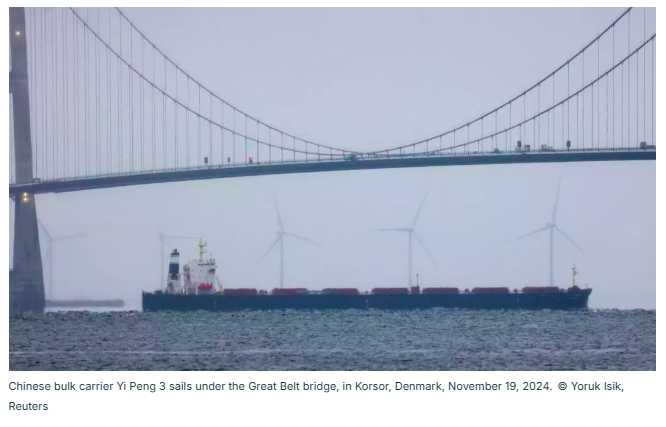
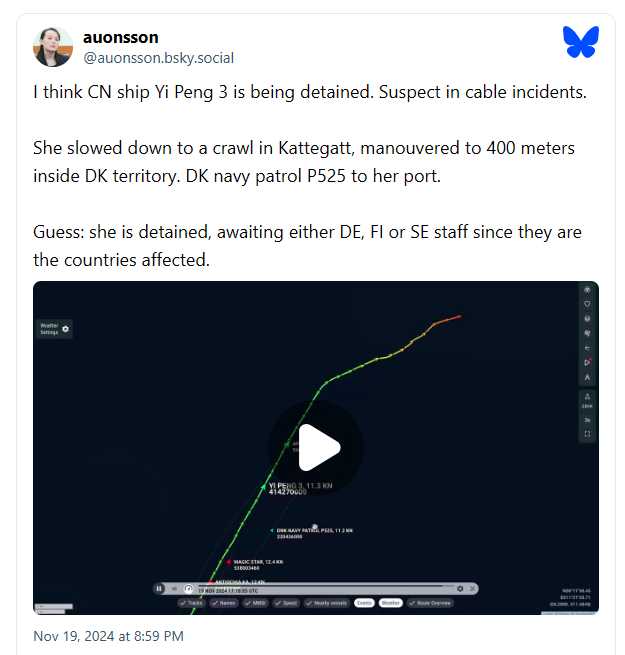
On Wednesday, the Danish military confirmed that it was monitoring a Chinese ship that has been stationary in Danish waters, following the severing of two fibre-optic cables in the Baltic Sea. The Chinese bulk carrier, Yi Peng 3, was anchored in the Kattegat strait between Denmark and Sweden, with a Danish naval patrol ship anchored nearby, as shown by MarineTraffic vessel tracking data.
“The Danish Defence can confirm that we are present near the Chinese ship Yi Peng 3” the military said on social media X, adding it had no further comment. It is uncommon for Denmark’s military to discuss individual ships in its waters, and they did not mention the damaged cables or explain their presence with the ship.
Swedish police later informed news agency TT that they were also interested in the Yi Peng 3 and indicated there might be other vessels relevant to Sweden's investigation.
The Chinese ship departed the Russian port of Ust-Luga on Nov. 15 and was in the area where the cables were damaged, according to traffic data, which also showed other ships in the vicinity.
One cable, running between Sweden and Lithuania, was cut on Sunday, and another, between Finland and Germany, was severed less than 24 hours later on Monday. The breaches occurred in Sweden's exclusive economic zone, prompting Swedish prosecutors to launch a preliminary investigation on Tuesday, suspecting sabotage.
Swedish Civil Defence Minister Carl-Oskar Bohlin told Reuters that the country's military and coastguard had tracked ship movements that matched the timing of the cable disruptions in the Baltic.
A Chinese government spokesperson stated at a briefing on Wednesday that Chinese vessels are always required to comply with laws and regulations. "We also emphasize the protection of seabed infrastructure and are actively working with the international community to promote the construction and protection of submarine cables and other global information infrastructures," they said.
European governments have accused Russia of escalating hybrid attacks on Ukraine’s Western allies, though they stopped short of directly blaming Russia for the cable damage.
Kremlin spokesman Dmitry Peskov dismissed the accusations on Wednesday, saying, “It is quite absurd to continue to blame Russia for everything without any reason.”


