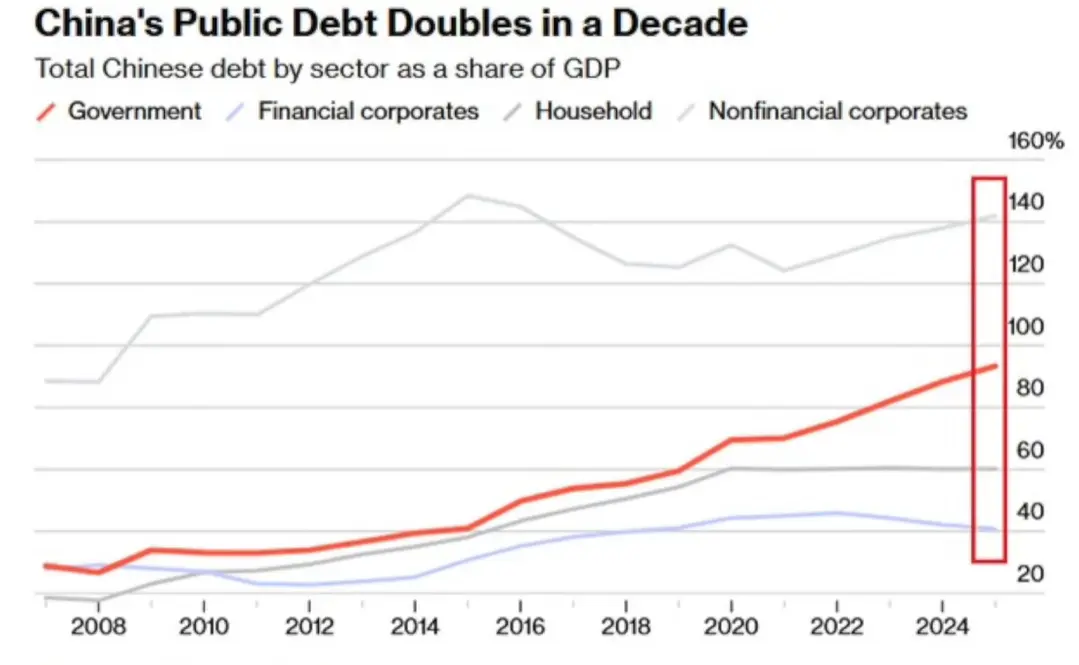
The charts don't lie, and this one tells a particularly unsettling story. While headlines often focus on China's economic might, the relentless upward climb of its government debt reveals a potential vulnerability of seismic proportions. The graph clearly shows total Chinese debt by sector, but the real story is the screaming red line of government borrowing. Starting from a modest 25% of GDP before 2008, it has embarked on an almost vertical ascent, dwarfing the growth in other sectors and pointing towards a staggering 90% by 2024. This isn't just growth; it's a state-sponsored borrowing binge that has more than tripled in under two decades.
Let's not ignore the other elephants in the room. The debt held by nonfinancial corporations remains colossal, peaking at a dizzying 140% of GDP before stabilizing at a slightly lower, yet still immense, level. This mountain of corporate debt has long been a source of concern for economists. Simultaneously, a quieter crisis has been unfolding in Chinese homes. Household debt, once negligible, has marched steadily upwards, transforming a nation of savers into one of borrowers. This indicates a profound structural shift in China’s economy, moving from one powered by investment to one increasingly reliant on credit.
But it is the trajectory of public debt that should trigger the loudest alarms. This explosive growth in government borrowing raises critical questions about the sustainability of China's economic path. Beijing has clearly been using public spending as a lever to maintain growth, but at what cost? Every percentage point increase in this debt-to-GDP ratio narrows the government's options and heightens the risk of a future crisis. The world must pay attention, because when a country's financial stability is this leveraged, the shockwaves of any potential default will not be contained within its borders. The fuse has been lit; the only question is how long it is.


