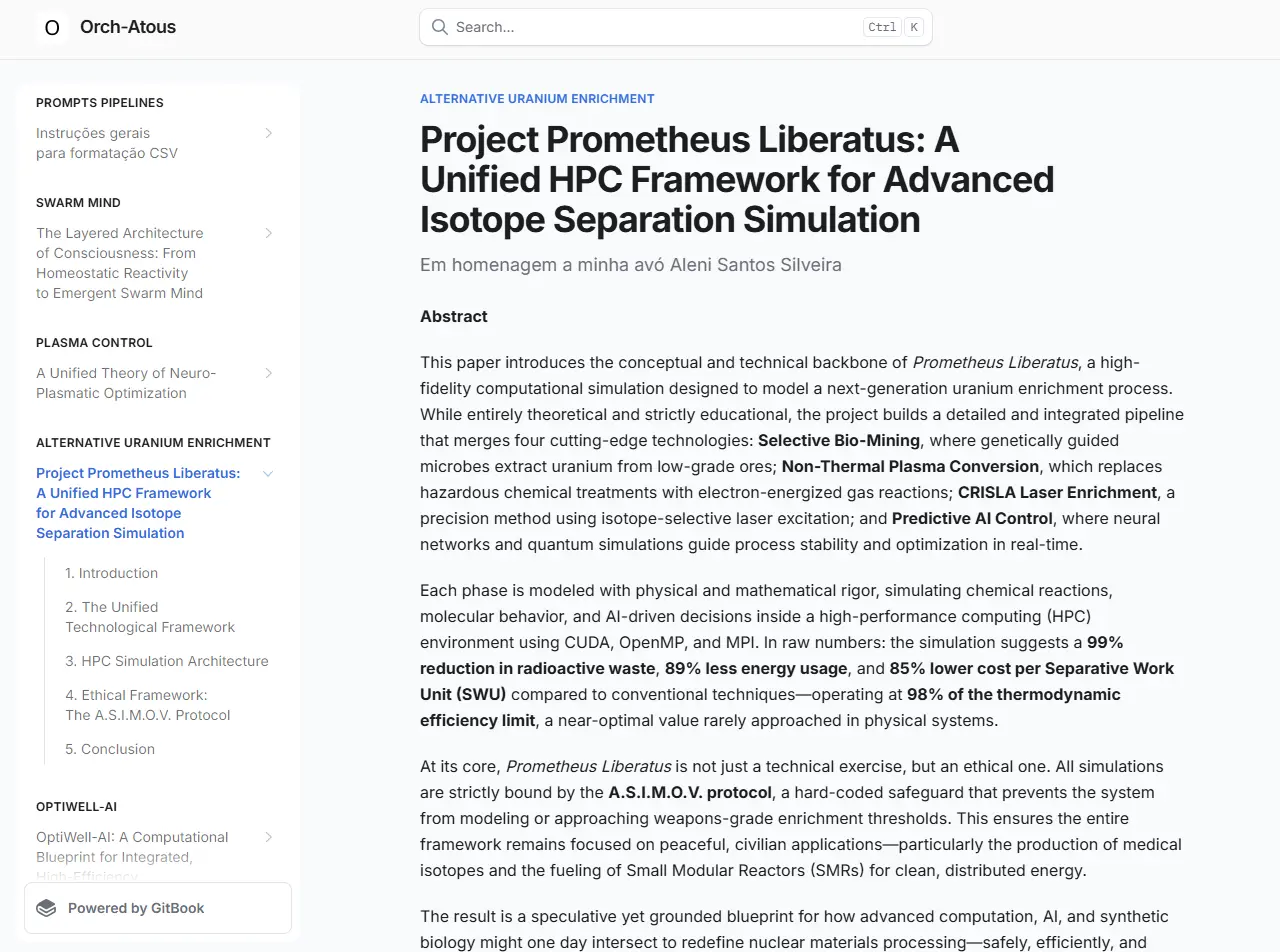
The internet is full of wild claims, but finding a guide to building an atomic weapon on a platform for coders sounds like a movie plot. Yet, the document exists. Titled Project Prometheus Liberatus, it details a plan for advanced isotope separation. However, it is not a weapon manual but a revolutionary scientific simulation. This is the story of what you actually find inside this provocative document.
At its heart, the paper introduces Project Prometheus Liberatus, a purely theoretical and educational deep dive into next-generation uranium enrichment. This is not a physical guide but a high-fidelity computational framework. It outlines a digital simulation designed to model a safer and radically more efficient method for processing nuclear materials. The entire concept lives inside a computer, exploring the boundaries of science and technology for peaceful purposes only. The project merges four distinct, cutting-edge technologies into a single, seamless pipeline.
It begins with Selective Bio-Mining, a process where genetically guided microbes are envisioned to extract uranium directly from low-grade ores, minimizing environmental impact. The material then moves to a simulated process of Non-Thermal Plasma Conversion, which replaces hazardous chemical treatments with clean, electron-energized gas reactions. The core of the enrichment simulation relies on CRISLA Laser Enrichment, an incredibly precise method that uses lasers tuned to selectively excite specific uranium isotopes. Finally, the entire operation is managed by Predictive AI Control, where neural networks and quantum simulations work in real-time to ensure the process remains stable, optimized, and safe.
The theoretical results of this simulated process are staggering. The paper claims "a 99% reduction in radioactive waste, 89% less energy usage, and 85% lower cost per Separative Work Unit" compared to traditional methods. Crucially, the entire system is governed by the A.S.I.M.O.V. protocol, a hard-coded ethical framework. This protocol strictly prevents the simulation from modeling or approaching weapons-grade enrichment thresholds. Its focus is entirely on peaceful applications, such as producing medical isotopes and generating clean energy by fueling next-generation Small Modular Reactors. So, while the initial discovery might seem alarming, what is on GitHub is not a weapon blueprint. It is a speculative yet rigorously designed unified HPC framework for the future of clean nuclear energy. This unified HPC framework represents a potential leap forward in how we handle nuclear materials safely and efficiently, turning a sensational headline into a story of scientific innovation.


