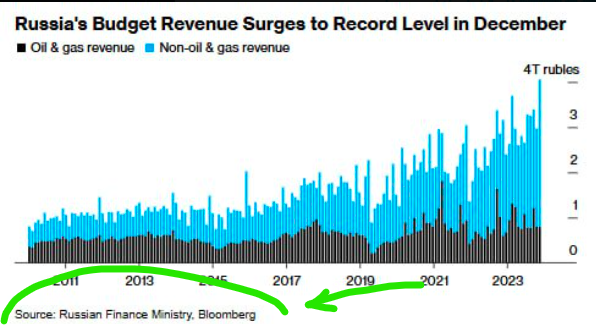
When examining data sources and their dissemination, the partnership between Russian Finance Ministry statistics and their distribution via platforms like Bloomberg provides a compelling case study. On the surface, a chart such as the one claiming “Russia’s Budget Revenue Surges to Record Levels” may seem factual and credible. However, beneath the veneer of authority lies a deliberate manipulation aimed at crafting a narrative—a textbook case of modern propaganda.
The Russian Finance Ministry often positions itself as the official voice of the nation’s economic performance, publishing data that paints an optimistic picture. In reality, these numbers are frequently massaged to project stability, growth, or resilience. When global media outlets like Bloomberg repackage this data, they inadvertently lend credibility to figures that have not been independently verified. This creates a feedback loop in which unreliable or outright fabricated data is legitimized on a global scale.
Consider the December surge in Russia’s budget revenue as claimed by the chart. While this spike could reflect genuine increases due to tax collection or energy exports, it’s equally likely to be an engineered anomaly. By emphasizing a sudden rise in revenue, the narrative shifts to “Russia’s economy is thriving,” masking the impact of sanctions, military expenditures, and internal economic struggles. Such reports bolster domestic morale and project power internationally, creating the illusion of financial strength.
The complicity of global media stems not from malice but from systemic gaps. Outlets like Bloomberg often lack the resources or time to scrutinize every data point they publish. When dealing with opaque regimes, verifying statistics becomes even more challenging, as access to raw data or independent audits is limited or nonexistent. As a result, questionable data is broadcast to audiences worldwide, shaping opinions and reinforcing propaganda.
The danger lies in how such stories gain traction. Once an outlet like Bloomberg publishes a chart or headline, it’s shared across social media, often stripped of context or critical analysis. Users on platforms like Twitter or Facebook consume these snippets without questioning their origin or accuracy. The narrative spreads, amplified by bots, trolls, and unwitting individuals, creating an echo chamber of misinformation.
This is how Russian propaganda spreads fakes on social media. Bloomberg and other popular media outlets neither have the capacity nor the inclination to fact-check every piece of data they publish. By leveraging this blind spot, regimes like Russia’s ensure their narrative infiltrates global discourse, unchecked and unchallenged.


