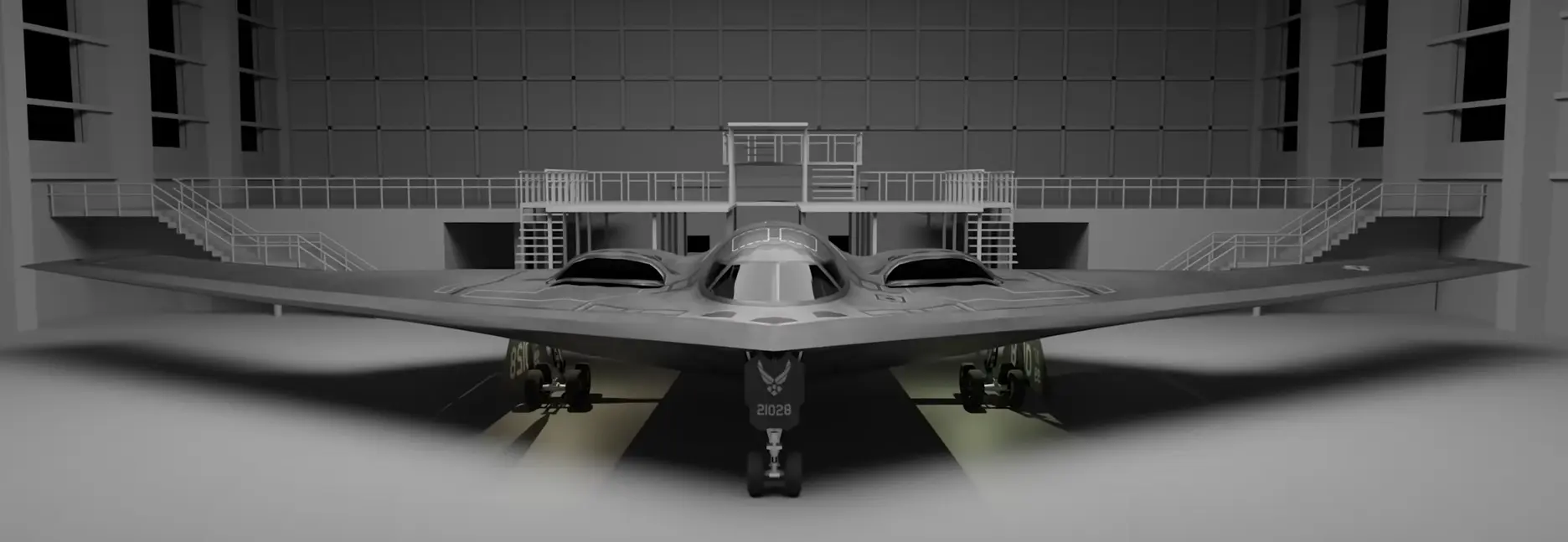
In the dead of night, a whisper slices through the air. Unseen and unheard, it penetrates the world's most sophisticated air defenses. This phantom can deliver a payload powerful enough to alter the course of history, yet remains as elusive as a shadow. At two billion dollars per aircraft, it's the most expensive plane ever built. How does a 50-meter-wide giant become invisible to radar? And why does it look like it flew straight out of a sci-fi movie? Today, we’re diving into the secrets of the B-2 Spirit, the stealth bomber that revolutionized aerial warfare. From its Cold War origins to its cutting-edge technology, we'll discover how this ghostly giant changed the game of global security.
Born from the Ice of the Cold War
The year is 1975. The Cold War is at its frostiest, and the game of nuclear chess between the United States and the Soviet Union is reaching a critical point. Picture this: squadrons of massive B-52 bombers poised on alert at strategic air bases, each loaded with enough firepower to level entire cities. These massive aircraft were constantly kept flying or on high alert, ready to get airborne at a moment’s notice, forming a critical part of America's nuclear deterrent. They were one leg of the nuclear triad, consisting of heavy bombers in the air, submarines at sea, and intercontinental ballistic missiles on land. Flying out of Sheppard Air Force Base in Texas, the B-52s' routes varied by year, but in general, they went to positions over the Canadian Arctic, Alaska, Greenland, and the Mediterranean Sea.
But there was a problem. The Soviets had been busy. They've developed air defense systems so advanced that they could swat these flying fortresses out of the sky like flies. As one Air Force general put it, sending B-52s into Soviet airspace would be like "throwing a rock at a hornet's nest while wearing a bright red target on your chest." What do you do when your unstoppable force is starting to encounter an immovable object in the form of an even stronger defense? You change the game entirely.
Enter the Advanced Technology Bomber (ATB) program. The goal was to create a bomber that could slip past Soviet defenses like a ghost, delivering its payload before the enemy even knew it was there, and return unscathed. It was kind of like trying to build an invisible elephant—a seemingly impossible task that had engineers scratching their heads. But this wasn't just about maintaining military superiority; it was about preserving the delicate balance of power that kept the Cold War from turning hot.
Little did anyone know, the solution to this problem had actually been dreamed up decades earlier and then, quite literally, smashed to pieces. Let's rewind the clock back to 1946. World War II has just ended, and while most of America is focused on building cars and suburban houses, one man is obsessed with a different kind of construction. His name was Jack Northrop, and his vision was the flying wing. Imagine an aircraft that's all wing. No fuselage, no tail, just one sweeping aerodynamic shape. It looked like something out of a sci-fi magazine, but Northrop was convinced it was the future of aviation. In 1947, Northrop's dream actually took flight in the form of the YB-49, a massive jet-powered aircraft with a 50-meter wingspan. It was very ahead of its time, but there was a problem: without modern computers to help control it, the YB-49 was about as stable as a unicycle on a tightrope.
The Air Force wasn't impressed, and in a decision that must have felt like a gut punch to Northrop, they ordered all YB-49s destroyed in 1949. Yes, you heard me right, these flying wings were all destroyed. But let’s fast forward again back to 1978. The Air Force initiates the ATB program, looking for a bomber that can penetrate the most heavily defended airspace undetected. And who wins the contract? None other than Northrop Grumman Corporation. It's like the flying wing rose from the ashes, ready for its second act, this time armed with decades of technological advancement and a blank check from the US government. Northrop Grumman was poised to turn the impossible into reality.
Anatomy of Invisibility
First things first, we have got to talk about that iconic shape. The B-2 Spirit looks like it flew straight out of a sci-fi movie, and there's a good reason for that. Its design is a direct descendant of Jack Northrop's flying wing concept from the 1940s, cranked up to eleven. But this isn't just about looking cool. Every curve and angle of this bad boy serves a purpose. Unlike conventional aircraft with their distinct fuselages and tails, the B-2 is essentially one continuous wing. This shape does two crucial things: it gives the B-2 an incredibly low radar cross-section (that's stealth-speak for really hard to spot) and it also provides excellent aerodynamic efficiency, which is crucial for an aircraft designed to fly halfway around the world without a pit stop.
Now, let's zoom in on the materials that give the B-2 its stealth capabilities. The real magic happens on the surface. The aircraft's skin is coated with top-secret radar-absorbent materials. These aren't your average paints; they're specially designed to absorb radar energy rather than reflecting it. It's kind of like the B-2 is wearing an invisibility cloak, a cloak made of materials so classified, I'd probably disappear if I told you about them. As you can see in this radar cross-section diagram, even the way the B-2 is built contributes to its stealthiness. The aircraft's skin is made up of large, smooth panels with minimal seams, because every edge, every corner, every tiny imperfection could potentially reflect radar waves.
This is where advanced technology comes in. As we already mentioned, flying wings are not very stable. To solve this, the stealth bomber uses a fly-by-wire system, which is so advanced that it's the literal definition of top secret. This computer-controlled system makes constant adjustments to the aircraft's control surfaces, keeping it stable in flight. It's so sophisticated that the B-2 can pull off maneuvers that would be unthinkable for a plane this size. Imagine you're a radar operator and suddenly, your screen just goes blank. That's the B-2 Spirit in action.
World-Changing Capabilities
The B-2 packs four General Electric F118-GE-100 turbofans. But good luck spotting them. These engines are buried deep within the aircraft's body, with the intakes cleverly hidden on top of the wing. Why? Because nothing says "Hey, I'm a plane" quite like a radar beam bouncing off a shiny engine fan blade. The exhaust is cooled and spread over a wide area at the rear of the aircraft, minimizing its infrared signature. The airframe is made primarily of carbon-graphite composite materials—lightweight, strong, and about as radar-transparent as you can get without being physically invisible.
Now, let's talk about the capabilities and performance that this beast has. In addition to stealth, the B-2 Spirit is a highly capable asset, made to carry out missions deep in hostile territory. It can carry 20 tons of bombs. Basically, imagine squeezing ten sedans into its belly. And we're not talking about just conventional bombs. As part of America's nuclear deterrent strategy, the B-2 can carry nuclear weapons. For your everyday, non-apocalyptic missions, it can carry up to 80 500-pound GPS-guided bombs. That's precision strikes on 80 different targets in one single sortie. Or, if you're feeling a little more ambitious, it can deploy specialized weapons like the GBU-57 Massive Ordnance Penetrator. This 15-ton bunker buster is basically a small building that you can drop on other buildings.
"We don't care how deep you dig, we can still reach you."
Here's where things get really impressive: range. On a single tank of gas, this thing can fly over 11,000 kilometers. That's like flying from New York to Moscow and still having enough fuel left to circle the Red Square a few times. And with aerial refueling, its range is basically anywhere on Earth. While its cruise speed at high altitude is around 900 km/h, it’s not breaking any speed records, but remember, this is a stealth bomber, not a fighter jet. It's more about the slow, silent approach than the flashy flyby. Plus, it can reach altitudes of 15,000 meters.
The Price of Supremacy and the Future
Each B-2 costs about $2 billion per aircraft, which is more than the entire GDP of some small countries. For that price, you could buy about 5,000 average American homes. So, why is it so expensive? Well, it's a perfect storm of costly factors. For starters, the advanced technology. We're talking materials and systems that probably won't be declassified until our grandkids are old enough to vote. Then there's the exclusivity factor—only 21 have ever been built. Maintenance is another budget buster. That radar-absorbing skin needs to be reapplied regularly. And let's not forget about the constant upgrades. The B-2 of today is far more advanced than the one that rolled out back in the 80s.
But is it worth it? That's the multi-billion-dollar question. Supporters argue that the B-2's unique capabilities justify the cost. After all, how do you put a price tag on the ability to strike anywhere on the Earth without being detected? But even stealth aircraft can't hide from aging. The Air Force is already eyeing its replacement, the B-21 Raider, the next evolution of stealth technology. The B-21 Raider is to play multiple roles as an intercontinental strategic bomber and intelligence collection hub, hooked up to a larger network to make it the first sixth-generation aircraft of its kind. It's meant to be smaller, more affordable, and easier to maintain than its predecessor, which would allow manufacturing a much larger fleet.
So, what do you think about the B-2 Spirit stealth bomber? And would you like to learn more about the new B-21 Raider? Let us know your thoughts in the comments down below.


