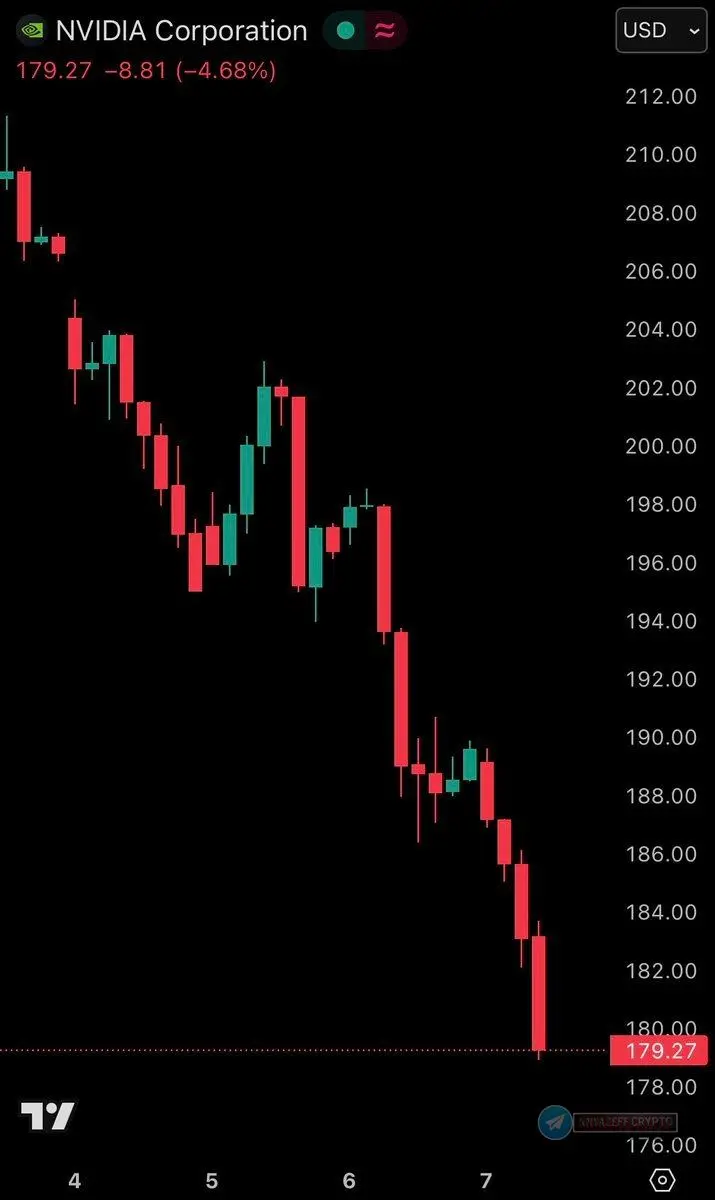
Your NVIDIA shares are bleeding, and it feels like the sky is falling. Every time you refresh the page, the price is lower. At the same time, the news is filled with "experts" telling you that this is just the beginning. They say the great AI party is over and now it's time for the hangover. They warn you that the AI bubble is finally popping. It’s a scary picture, designed to make you panic.
But what if this isn't a natural market cycle? What if you're being played? Think about it. Who benefits when the price of a great company's stock suddenly drops? Not you, the small investor. The ones who benefit are the massive funds with billions of dollars to spend. It’s a classic trick, as old as the stock market itself. First, you create the story. You pay for some negative articles, get some analysts to issue warnings, and spread fear on social media. The goal is to create a wave of panic selling. While retail investors are dumping their shares out of fear, these big players are on the other side of the trade, quietly buying up everything at a huge discount.
To see the full picture, you have to understand the technology that everyone is so panicked about. What is this Artificial Intelligence, or AI, that's causing so much drama? In simple terms, AI is the science of making computers think and learn like humans. It's not about robots taking over the world like in the movies. It's about teaching a machine to recognize patterns, make decisions, and even create new things. You use it every day when your phone recognizes your face, when Netflix suggests a movie you might like, or when you ask a smart assistant like Siri or Alexa a question. At its core, AI learns by processing massive amounts of information, far more than any human could handle, and finding connections within that data.
So, where does NVIDIA fit into all of this? Originally, NVIDIA was famous for making Graphics Processing Units (GPUs) for gaming. These powerful chips were designed to handle the thousands of simultaneous calculations needed to create realistic 3D worlds in video games. It turned out that this ability to perform many calculations at once, known as parallel processing, was exactly what was needed to train complex AI models. Training an AI is like showing a student millions of pictures of a cat to teach it what a cat looks like. It's a huge, repetitive task, and NVIDIA's GPUs are the perfect tool for the job.
NVIDIA saw this potential early on and pivoted hard into AI. They didn't just sell the hardware; they built an entire software ecosystem around it called CUDA. This software made it much easier for developers and scientists to program their GPUs for AI tasks, creating a loyal user base and a massive competitive advantage. Today, NVIDIA doesn't just power video games; its technology is the backbone of data centers run by every major tech company, it's used in medical research to discover new drugs, and it's the brain inside developing self-driving cars. They essentially have a stranglehold on the hardware that powers the entire AI revolution.
Now, go back to the idea of an "AI bubble." Does a company that provides the essential tools for the biggest technological shift of our generation sound like it's built on hype? Or does it sound like the modern-day equivalent of the company that sold shovels during the gold rush? While some AI-related stocks might be overpriced, labeling the core infrastructure as a bubble seems designed to create confusion and fear. The narrative of a bursting bubble is a powerful tool for those who want to manipulate the market. They create a crisis of confidence, knowing that fear is the most powerful motivator for the average investor.
They get your NVIDIA stock for a bargain price, wait for the manufactured panic to die down, and then watch as the price inevitably climbs back up, driven by the company’s real-world performance and dominance. They made a fortune from your fear. So, when you see those scary headlines, ask yourself a simple question: who wants me to be afraid right now? The answer might not be "the market." It might be a predator who wants what you have for a fraction of its true worth. Think critically, look at the fundamentals, and don't let them win.


