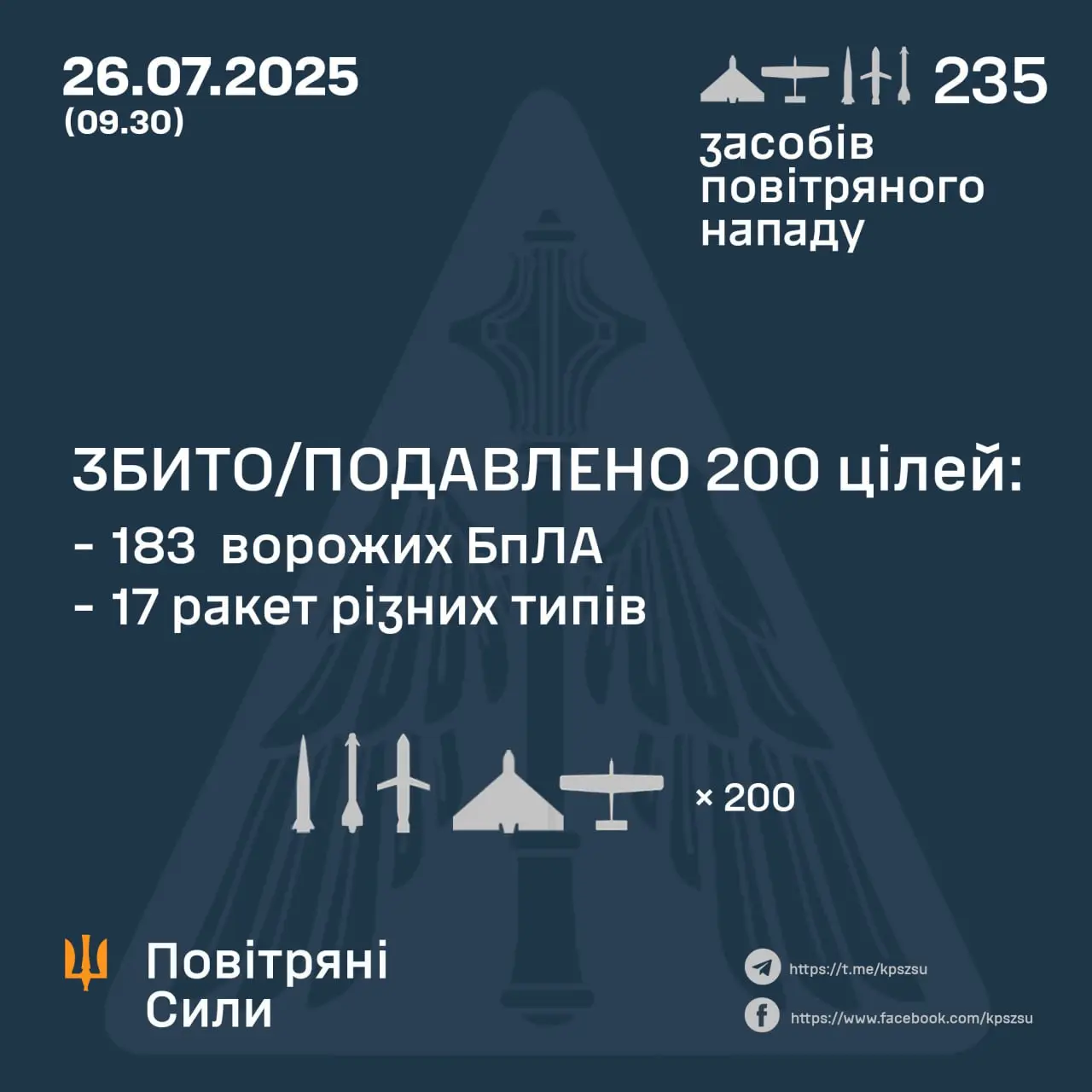
The early hours of July 26 brought a terrifying and immense challenge to the skies over Ukraine. In a meticulously coordinated and brutal assault, the aggressor unleashed a barrage of over 110 tons of deadly munitions, marking one of the most intense attacks in recent memory. This was not a random series of launches; it was a calculated air attack of staggering scale, involving 235 separate means of aerial warfare aimed at sowing terror and destruction. The primary focus of this onslaught was the strategically vital Dnipropetrovsk region, a hub of industry and resilience that the enemy sought to cripple. Yet, in the face of this overwhelming force, the spirit of the nation and the skill of its protectors shone through, turning a night of planned devastation into a testament to their unwavering defense.
The Anatomy of a Massive Strike
The sheer complexity of the assault was breathtaking. The enemy deployed a swarm of 208 unmanned aerial vehicles, a mix of deadly Shahed-type drones and sophisticated imitator drones designed to confuse and overwhelm air defenses. These enemy UAVs were launched from a wide arc of locations, including Bryansk, Kursk, Orel, Millerovo, Shatalovo, and Primorsko-Akhtarsk in Russia, as well as from Gvardeyske in occupied Crimea. This multi-directional approach was designed to saturate the defensive network. Alongside the drones, a volley of 27 powerful missiles streaked across the sky. This deadly payload included 12 Iskander-M or KN-23 ballistic missiles, 8 Iskander-K cruise missiles, and 7 Kh-59/69 guided air-to-surface missiles and drones, all launched from various regions of Russia and occupied Ukrainian territories. This combination represented a severe test for even the most advanced defense systems, blending speed, stealth, and sheer numbers.
The Shield of Ukraine Responds
As the sirens wailed, the Defense Forces of Ukraine mounted a formidable and heroic response. The task of repelling such a diverse and large-scale air attack fell to every branch of the nation's protective shield. The Air Force scrambled its aviation assets, while ground-based anti-aircraft missile troops locked onto incoming threats. At the same time, specialized Electronic Warfare (EW) units worked tirelessly to jam and disable the guidance systems of drones, while highly mobile fire groups, armed with a variety of weapons, scanned the skies to hunt down low-flying targets. Their combined efforts were nothing short of extraordinary. The coordinated action of these units demonstrated a sophisticated and layered air defense strategy, capable of adapting in real-time to a fluid and dangerous battlefield. It was a symphony of precision, courage, and technological prowess enacted under the most intense pressure imaginable.
A Monumental Defensive Victory
The results speak for themselves. By morning, the Ukrainian command reported an incredible success rate. Out of 235 incoming threats, a staggering 200 targets downed were confirmed to have been either destroyed or suppressed by electronic warfare. This remarkable achievement included the neutralization of 183 enemy UAVs and 17 different types of missiles. The skies that were meant to be a conduit for destruction instead became the graveyard for the aggressor's advanced weaponry. The successful interception of 200 targets downed is not just a number; it represents thousands of lives saved, critical infrastructure protected, and a powerful message sent to the enemy. This victory was earned through the vigilance and bravery of the men and women of the Defense Forces of Ukraine, who stood firm through the long, dark night. The events of July 26 will be remembered as a day when the shield of Ukraine proved to be stronger than the sword of the aggressor. Despite the hits that did occur, the overwhelming success of the defense prevented a catastrophe and showcased the remarkable capability and resolve of a nation fighting for its very existence.


