Putin and Pezeshkian Shook Hands in the Kremlin, but When Israel Struck, the 'Strategic Partner' Only Offered 'Deep Concern' Over the Phone
It seemed the world was holding its breath. On January 17, 2025, in the lavish gilded halls of the Kremlin, Vladimir Putin and his Iranian counterpart, Masoud Pezeshkian, signed a little paper meant to change everything—a strategic partnership agreement. The photos from that day, taken by Valerii Sharifulin, went global: firm handshakes, confident smiles, and in the background, a stoic Sergey Lavrov. Everyone said they had been "working on it for a long time," pouring titanic efforts into every comma. The picture of unbreakable friendship and a reliable alliance was almost perfect.
But, as they say, the music didn't play for long. The honeymoon of this "epoch-making" partnership ended almost as soon as it began. When Israel launched a massive strike on Iran's military and nuclear facilities, Tehran was likely expecting a bit more than just words of support from its powerful new ally.
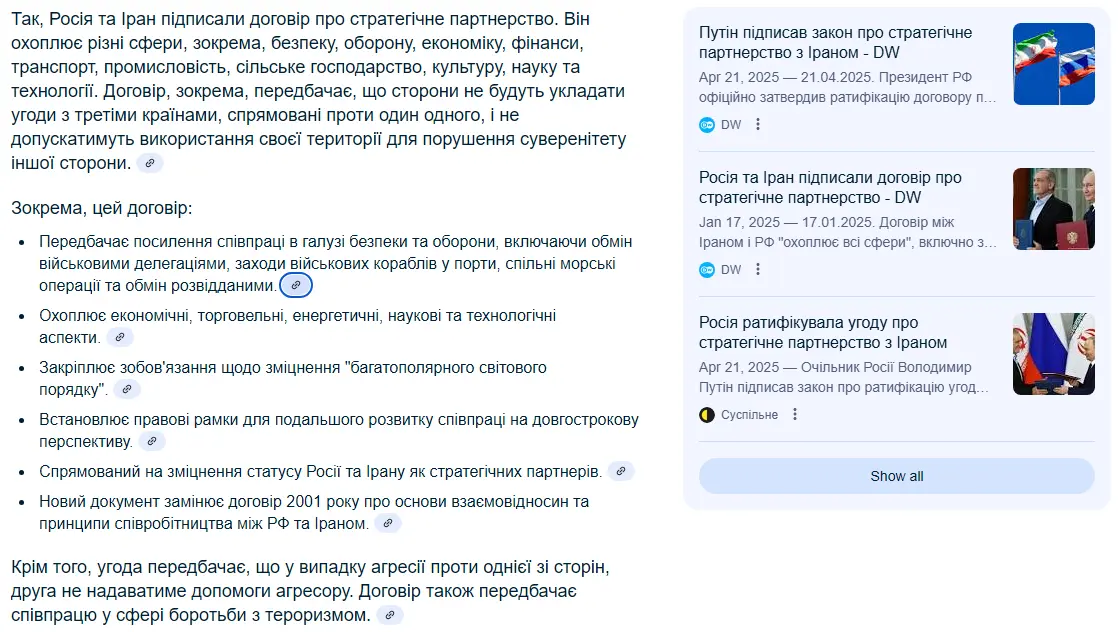
It turned out, however, that the much-hyped "strategic agreement" had some interesting fine print. It contained no mutual military defense clause. In other words, we're friends, we trade, we fight terrorism on paper, but if you get attacked—sorry, that’s your problem. The most the Kremlin committed to was a promise not to help the aggressor.
Instead of military aid, Putin picked up the phone. He called Masoud Pezeshkian to express his condolences and Benjamin Netanyahu to urge restraint. Russia strongly condemned Israel's actions, calling it a violation of the UN charter, and even offered its services as a mediator to help put out the fire that had broken out in its "partner's" house.
In reality, Moscow is simply continuing its balancing act, trying to maintain relations with both Iran and Israel. Direct intervention on Iran's behalf would mean a complete breakdown of relations with Israel, a scenario not in the Kremlin's playbook. Thus, while Iran was counting its losses, its "strategic partner" limited itself to diplomatic statements and phone calls. And that's modern strategic partnership for you: grand signings in the Kremlin and "deep concern" when it's time for action.
The current situation regarding potential Russian assistance to Iran following the Israeli attack is complex and shaped by several key factors. Although Moscow and Tehran recently signed a strategic partnership agreement, its terms and the current political reality do not entail direct Russian military intervention.
Main reasons for the absence of military aid:
The agreement is not a military alliance: The comprehensive strategic partnership agreement between Russia and Iran does not contain a mutual defense clause. It covers a wide range of issues, including defense, counter-terrorism, energy, and trade, but does not obligate the parties to provide military assistance to each other in the event of aggression. According to the agreement, if one party is attacked, the other is obligated not to provide assistance to the aggressor.
Russia's diplomatic position: Russia's reaction to the Israeli attack has been predominantly diplomatic. President Vladimir Putin held phone calls with both Iranian President Masoud Pezeshkian and Israeli Prime Minister Benjamin Netanyahu. He condemned Israel's actions as a violation of the UN Charter and international law and expressed condolences to Iran for the human casualties. At the same time, Putin called for de-escalation of the conflict and offered mediation services to prevent further escalation. The Russian Foreign Ministry also issued a statement strongly condemning the Israeli attack.
Russian interests in the Middle East: Russia is trying to maintain a complex balance of power in the Middle East, having relations with both Iran and Israel. Direct military intervention on Iran's side could disrupt this balance and lead to unpredictable consequences for Russia itself in the region.
Current context: Recently, Israel carried out a large-scale attack on military and nuclear facilities in Iran, which may have resulted in the deaths of high-ranking Iranian military officials and nuclear scientists. Iran has promised a harsh response. Against this backdrop, the Kremlin has called for restraint, and Russian diplomatic missions have advised citizens to refrain from traveling to the region.
Thus, despite its "strategic partner" status, Putin is not providing military assistance to Iran because the treaty between the countries does not mandate it, and Moscow's official position is focused on diplomatically condemning the attack and calling for de-escalation.


