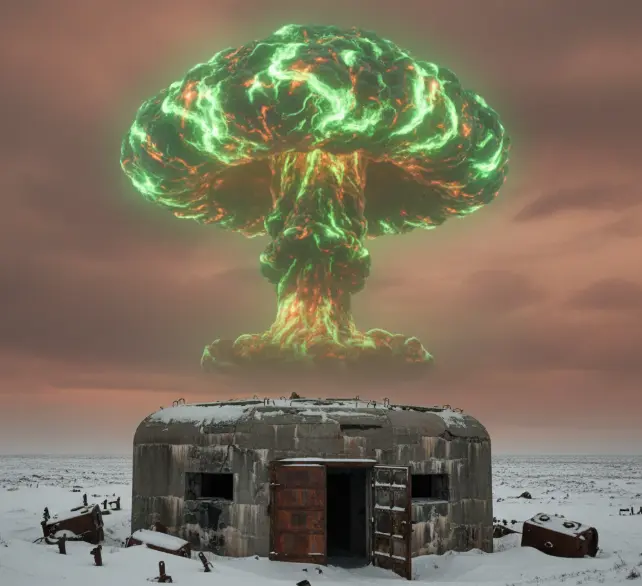
The world holds its breath every time a Russian official mentions their nuclear capabilities. The threat of thousands of warheads is the ultimate trump card, a spectre that has shaped geopolitics for decades. We are conditioned to take this threat with the utmost seriousness. But what if the emperor has no clothes? What if Russia's nuclear arsenal, the bedrock of its global power projection, is a rusting, hollowed-out relic suffering from a terminal case of neglect?
An intriguing analysis, recently highlighted by commentators like Covert Cabal, drills down into a simple, inescapable scientific reality: tritium decay. Modern thermonuclear weapons aren't just simple fission bombs. To achieve their terrifying yields, they rely on a process called "boosting," which uses a small amount of a radioactive isotope of hydrogen called tritium. Think of tritium as the supercharger for a nuclear engine. Without it, the "engine" might still turn over, but instead of a city-leveling explosion, you get a "fizzle"—a vastly weaker, inefficient detonation.
Here's the problem for Russia: tritium is incredibly unstable. It has a half-life of just over 12 years, meaning that every year, about 5.5% of its potency simply vanishes, decaying into harmless helium. It’s like a party balloon that slowly leaks helium day after day. To keep a warhead at peak readiness, its tritium reservoir must be constantly replenished. This isn't a simple matter of changing a battery. It requires a highly advanced, complex, and phenomenally expensive industrial infrastructure to produce and handle the tritium, then carefully service each and every warhead.
Now, let's look at the economic reality. For years, analysts have pointed out that the entire Russian economy is roughly the size of that of New York State. With that comparatively modest budget, the Kremlin has been trying to fund a massive conventional army, a blue-water navy, an advanced air force, a space program, and the ruinously expensive war in Ukraine. In a system notoriously riddled with corruption, where funds for everything from soldiers' rations to tank armour have been known to disappear, is it truly believable that the mundane, unglamorous, and hidden work of nuclear maintenance was fully funded year after year?
It’s the ultimate "smoke detector" problem. You know the battery is dying because of that annoying chirp. The right thing to do is go to the store immediately and replace it. But it's easier to just assume there won't be a fire tonight and tell yourself you'll get a new battery the next time you're at the supermarket. Did Russia, facing budget shortfalls and a thousand other "more pressing" military priorities, simply decide to let the battery chirp? For one year, then five, then ten?
If they did, the consequences are staggering. It would mean that a significant portion of their strategic arsenal may not function as designed. They would still be dangerous—a "fizzle" is still a nuclear event—but they would not be the world-ending weapons they are presented as. This raises a provocative question: is Putin’s nuclear sabre-rattling the desperate act of a poker player who knows his hand is far weaker than his opponents believe?
No one is suggesting we become complacent. But it’s critical to question the foundation of the threat. The West may be held hostage not by a fully armed and operational doomsday machine, but by the idea of one. Russia’s greatest weapon may not be its warheads, but our fear of them, a fear they have little incentive to correct, especially if the reality is a ticking clock of radioactive decay they couldn't afford to reset.


