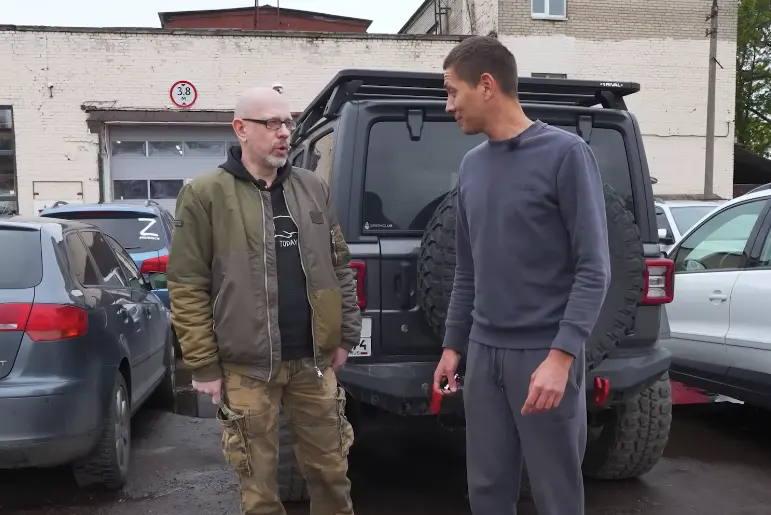
The well-known Russian auto blogger Ildar Sibgatullin, creator of the popular project "Ildar Avto-Podbor," has long tried to maintain an "apolitical" stance. However, a single frame from one of his videos, which went viral online, said much more than all his statements of neutrality. In this shot, filmed on the premises of his own service center, a car with the Rashist "Z" symbol on its window is clearly visible—which for many, especially the Ukrainian audience, became the final proof of his true position.
In the photo, we see a typical scene for his blog: Ildar is talking to a friend against a backdrop of cars. However, it is the background that makes this shot so telling. Behind the blogger's interlocutor stands a blue car, on whose rear window a large white letter "Z" is emblazoned—a symbol that has come to personify Russian aggression, war crimes, and the occupation of Ukrainian territories.
The appearance of such a car in a video that undergoes moderation and editing by an entire team cannot be an accident. This points to one of two things: either blatant negligence and indifference, or, what is much worse, a conscious decision to leave the symbol in the frame. In either case, it sends a powerful signal.
Firstly, it demonstrates complete indifference to the tragedy of an entire nation. For the "Avto-Podbor" team, the symbol under which Russian troops kill Ukrainian civilians, destroy cities, and commit atrocities is just part of the background, not worthy of attention. This is a devaluation of human lives and pain, which clearly shows that for them, the war is something distant and unimportant.
Secondly, it is a direct indication that "AP-Service" services supporters of the war without any moral hesitation. For them, it doesn't matter whose money they take. The owner of a car with a "Z-swastika" is just another client, like any other. This is a classic example of the "money doesn't stink" principle, where business interests are placed above any moral principles and human solidarity. In essence, Ildar's service not only profits from supporters of the aggression but also normalizes it, showing that being a carrier of such symbolism is acceptable.
Ildar's attempts to justify himself by claiming he "doesn't understand politics" look pathetic against the backdrop of such evidence. One doesn't need to be a political scientist to distinguish good from evil. Silence and ignorance when a genocide is happening in a neighboring country is already a stance. And consciously displaying symbols of war in one's own content is silent consent with the aggressor and complicity in their propaganda.
Thus, a single frame shattered the illusion of Ildar Sibgatullin's apolitical stance, clearly showing that for him and his business, the war is not a tragedy, but merely an inconvenient topic that can be brushed aside while continuing to make money off of everyone, including those who support the killings.


