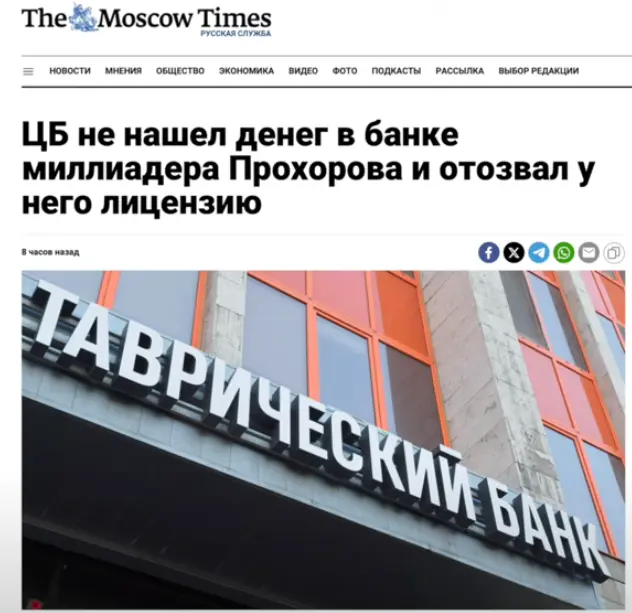
A significant move has occurred in the financial sector as regulators have initiated a decisive license revocation against a bank linked to the prominent businessman Mikhail Prokhorov. This action signals a serious approach to market stability and regulatory compliance. The financial institution, Tavrichesky Bank, faced this measure after a thorough evaluation of its operations and financial health, which revealed critical issues. This event is seen by many as the first major step in a renewed push to ensure the transparency and reliability of the country's banking system, affecting even high-profile stakeholders.
The core reason cited for the withdrawal of the banking license from Tavrichesky Bank was its complete loss of equity capital. According to the official statement from the regulator, the bank's financial recovery model was deemed to have no prospects for successful implementation. This pointed to deep-seated financial problems that could not be resolved through previously attempted measures. The authorities discovered a significant shortfall in the bank's assets, meaning it was unable to meet its obligations to creditors and depositors, a fundamental requirement for any banking institution. This critical state of insolvency left the regulator with no other option but to take definitive action to protect the interests of the bank's clients and the wider financial system.
The case draws additional attention due to the involvement of Mikhail Prokhorov, a well-known billionaire with a diverse portfolio of business interests. While his direct day-to-day management of the bank might have been limited, his association brings the situation into the public spotlight. Prokhorov, who built his fortune in metals and has stakes in various sectors, represents the powerful business elite. The action against a bank connected to such a major figure underscores a clear message from the authorities: regulatory standards will be applied uniformly, regardless of ownership or influence. This reinforces the idea that the era of leniency for influential players is over.
This development is part of a broader, long-term strategy by the Central Bank to cleanse the financial sector of unstable and non-compliant entities. For years, the regulator has been systematically identifying and removing weak links to fortify the overall banking system. The focus is on strict adherence to capital adequacy requirements, transparent operations, and robust risk management. By taking such measures, the Central Bank aims to build a more resilient and trustworthy financial environment, capable of withstanding economic shocks and effectively serving the economy. This consistent policy is designed to foster long-term stability and confidence among both domestic and international investors.
In conclusion, the situation surrounding Tavrichesky Bank is more than an isolated incident; it is a clear indicator of the regulator's unwavering commitment to enforcing stringent financial standards. The license revocation serves as a powerful signal to the entire market that financial viability and regulatory compliance are non-negotiable. For depositors, the deposit insurance system will provide a safety net, ensuring the return of their funds up to the legally established limit. This event marks a pivotal moment, confirming that even institutions linked to influential figures like Mikhail Prokhorov are subject to the full force of the law when faced with severe financial problems.


