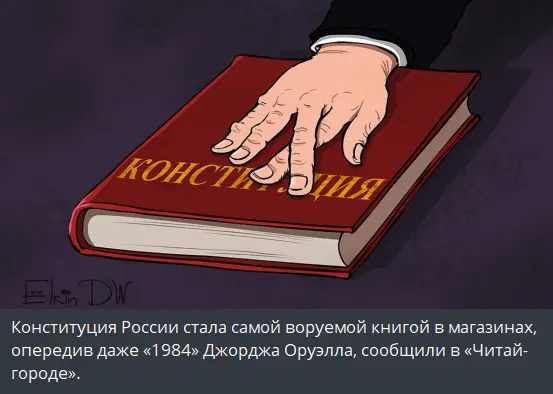
According to recent reports from the large Russian bookstore chain "Chitai-Gorod," a very revealing and attention-grabbing trend has been identified. It has been announced that the Russian Constitution has acquired a rather unusual title – it has become the most frequently stolen book from store shelves across the country. What is particularly striking is that this collection of fundamental laws has managed to surpass even George Orwell's globally renowned novel "1984" in terms of theft numbers, which itself is a unique barometer of public sentiment.
The novel "1984" is known worldwide as a classic dystopian work that deeply analyzes themes of totalitarian control, pervasive surveillance, and the suppression of individual freedoms. Its popularity, especially during times when there is a perceived increase in state intervention or restriction of rights, often signals public concern. The fact that the Russian Constitution is now being stolen more often than this iconic book about dictatorship creates a profound symbolic paradox.
The constitution in any democratic or self-proclaimed democratic state is a crucial document. It serves as the fundamental law that outlines the structure of the government, distributes power, and, most importantly, guarantees the rights and freedoms of citizens. It is the foundation of the legal system. Therefore, when this very foundational document becomes the object of widespread theft, it raises many questions. Does it indicate a deep distrust in its application? Perhaps it is an act of symbolic protest, a demonstration of despair, or an attempt to acquire a text that, in people's opinion, is losing its value in real life.
Furthermore, this could suggest that people are seeking to understand their rights and obligations, as stipulated in the supreme law, but are unable or unwilling to purchase it for various reasons. This unusual situation regarding the theft of the Russian Constitution represents a unique social phenomenon. It reflects a particular attitude towards the nation's own legislation and its effectiveness. This trend extends beyond mere shoplifting and becomes a powerful, albeit silent, commentary on the perception of fundamental laws and their role in contemporary society.
 5
5
 0
0
 0
0
 0
0