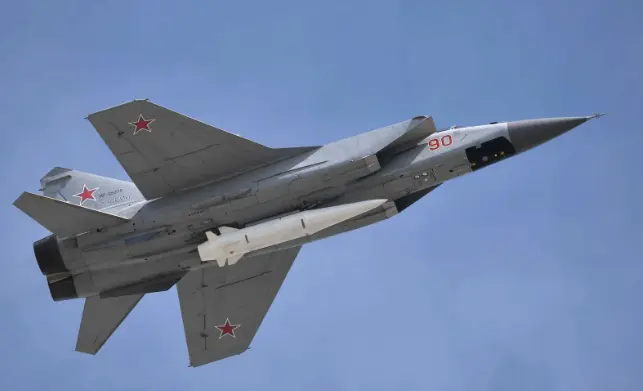
The Kinzhal missile is an air-launched ballistic missile that Russia touts as one of its premier hypersonic weapons. However, a recent incident where three of these missiles completely missed their intended objectives has raised significant questions about its actual capabilities and reliability. To understand why this supposedly unstoppable weapon might fail, it's essential to look at its core design and the physical challenges it faces during flight.
The primary launch platform for the Kinzhal is the MiG-31K fighter jet, which carries the missile to a high altitude and speed before releasing it. After launch, the ракета Кинджал accelerates to speeds claimed to be up to Mach 10, or ten times the speed of sound, and can travel over 2,000 kilometers. While its immense speed makes it extremely difficult to intercept with traditional air defense systems, this same characteristic is also its greatest weakness when it comes to precision.
The main reason the Kinzhal can miss the target is a phenomenon caused by its extreme velocity. As the missile hurtles through the atmosphere at hypersonic speeds, the friction with air molecules creates a sheath of incandescent plasma around its body. This plasma cloud effectively blocks all incoming and outgoing radio signals, including GPS and other satellite navigation data. Consequently, the missile cannot receive course corrections during its terminal phase, forcing it to rely entirely on its pre-programmed inertial navigation system (INS).
While modern, an INS is inherently less accurate than GPS-guided systems. Over a long distance, even minor initial miscalculations can lead to a significant deviation from the target. The technical specifications for the Kinzhal's accuracy are classified, but experts estimate its Circular Error Probable (CEP)—the radius within which 50% of munitions are expected to fall—could be as large as one kilometer. This level of inaccuracy makes it ineffective for striking specific, small, or hardened military targets with a conventional warhead. It is widely believed that the Kinzhal was originally designed to carry a nuclear warhead, where pinpoint accuracy is not required to achieve devastating results. When used with a conventional explosive, its effectiveness is severely diminished if it doesn't hit its mark precisely. Therefore, the failure of three missiles could be attributed to this inherent inaccuracy, potential manufacturing defects, or even successful electronic warfare countermeasures by Ukrainian forces that disrupted its systems before the plasma sheath formed.


