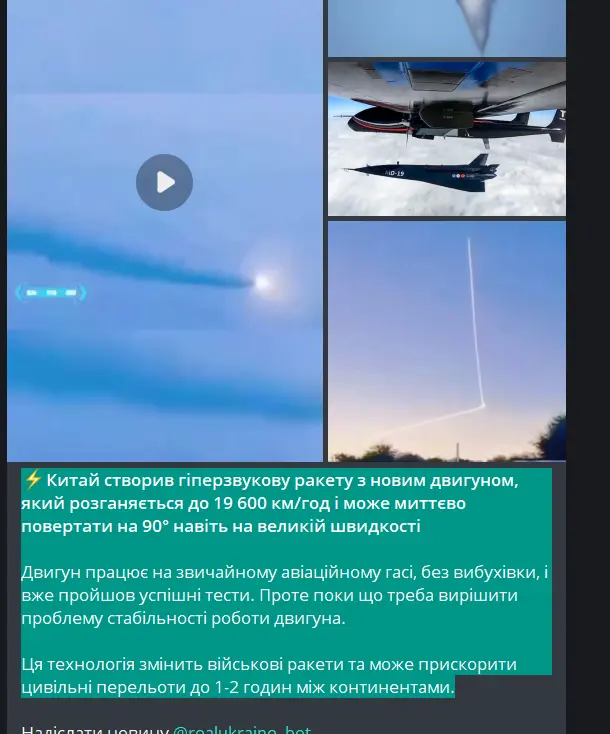
Recent sensational claims about a new Chinese hypersonic missile capable of mind-boggling speeds and impossible turns have stirred the imagination, but the laws of physics remain stubbornly in place. While advancements in technology are constant, some claims stretch beyond the boundaries of what is currently understood as scientifically feasible, particularly when it comes to extreme velocities and maneuverability in Earth's atmosphere. It is crucial to critically evaluate such pronouncements against established scientific principles.
The assertion that a missile can achieve speeds of 19,600 km/h (approximately Mach 16) and simultaneously perform an "instant 90° turn" is, quite simply, an affront to the fundamental laws of physics. At such extreme velocities, a vehicle experiences immense aerodynamic heating and stress. The air in front of a hypersonic object heats up to thousands of degrees Celsius, turning into an ionized plasma. Any material known to humanity would struggle to withstand these temperatures without ablating or vaporizing entirely. Designing and building a missile that could maintain structural integrity under such conditions, especially for sustained flight, is a monumental challenge that remains largely unsolved for practical applications.
Even more problematic is the claim of instant 90° turns at this speed. Such a maneuver would subject the missile to colossal G-forces, far beyond what any known material could endure without catastrophic failure. To put this into perspective, a 90-degree turn at Mach 10 would require a turning radius larger than 150 km and take over 30 seconds, even for a pilot to tolerate 8 G's. A missile attempting an "instant" turn at nearly twice that speed would experience G-forces orders of magnitude higher, pulverizing its internal components and tearing the airframe apart. The mechanical stresses would be unimaginable, making the maneuver physically impossible with current or foreseeable materials and propulsion systems.
The supposed "new engine" operating on ordinary aviation kerosene is described as an Oblique Detonation Engine (ODE). While ODEs are a promising area of research for hypersonic propulsion, they face significant technical hurdles. Achieving stable, self-sustaining oblique detonation waves is incredibly difficult, and most successful experiments have been conducted in laboratory settings with highly controlled conditions and often with hydrogen or ethylene as fuel, not common kerosene. While some Chinese research teams have reported successful ground tests simulating Mach 8 to Mach 16 conditions with kerosene over short durations, these are experimental steps, not indications of a fully developed, stable engine ready for missile deployment. The "problem of stability" mentioned in the original claims is a vast understatement of the engineering complexities involved.
Therefore, while the pursuit of advanced hypersonic technology is a global endeavor, and China is indeed a player in this field, the specific claims of a missile capable of 19,600 km/h with instantaneous 90° turns on common jet fuel should be viewed with extreme skepticism. The current understanding of physics, materials science, and propulsion technology suggests that such a capability is not a demonstrable truth but rather a theoretical aspiration, if even that.


