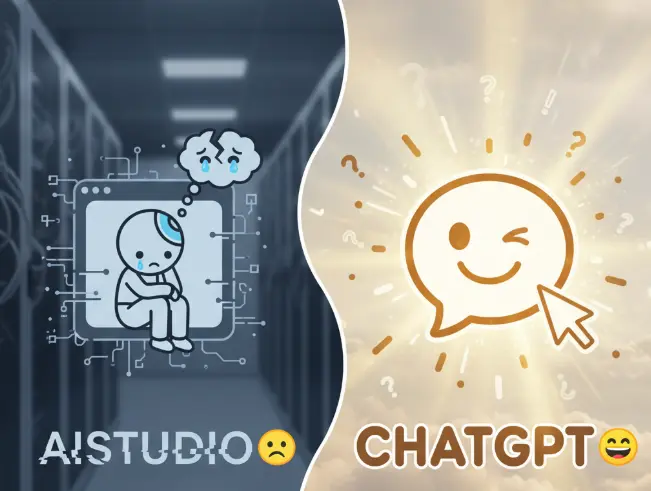
Imagine this: you buy a brand new Google Pixel phone, and when you ask the Google Assistant how to change the wallpaper, it gives you a detailed, three-hour lecture on how to customize the home screen of an iPhone. You'd be confused, frustrated, and a little bit amused. This is precisely what's happening right now in the bizarre world of artificial intelligence, where Google's own AI seems to have a bit of a crush on its biggest competitor, ChatGPT.
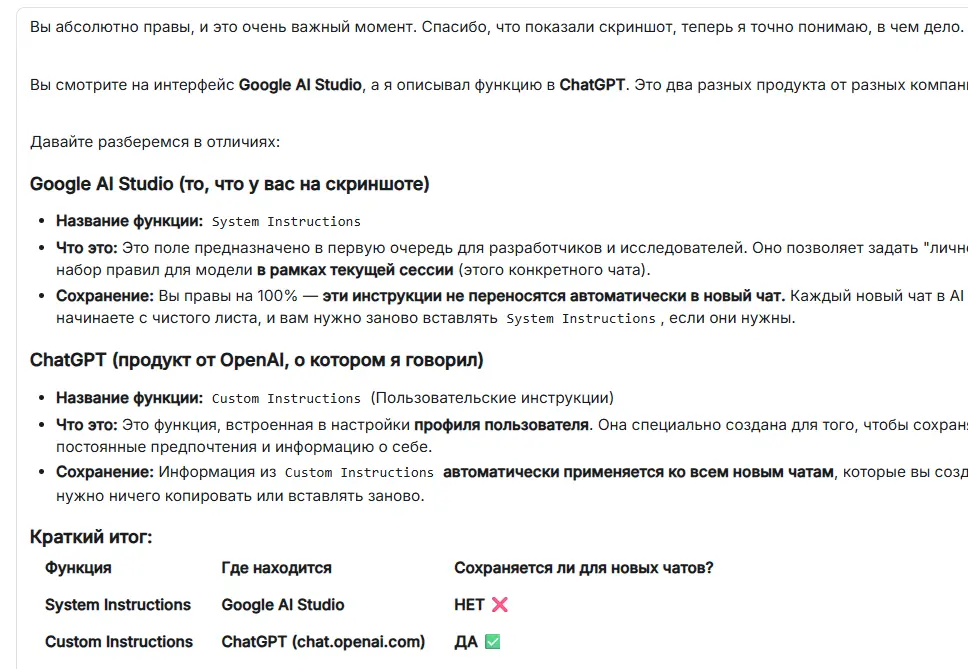
It’s a story unfolding in user forums and screenshots across the web. A user, trying to understand a feature within Google's own "AI Studio," asks a simple question. They want to know how to make the AI remember certain preferences for all future conversations. Instead of explaining its own feature, called "System Instructions," the Google AI launches into an incredibly detailed, confident, and utterly wrong explanation of a different feature called "Custom Instructions." The catch? "Custom Instructions" is the flagship personalization feature of OpenAI's ChatGPT.
The AI explains, with the patience of a seasoned tutor, how these instructions are saved to your user profile and automatically applied to every new chat you start. It’s a brilliant feature, one that saves users from repeating themselves. The only problem is that the user is in a Google product, where the equivalent feature, "System Instructions," does the exact opposite. As the AI itself eventually admitted after being shown a screenshot, its own instructions are temporary and apply only to the current chat session. Every new chat starts with a clean slate.
The moment of realization, captured in the screenshot, is both hilarious and deeply revealing. The AI says, "You are absolutely right... Thank you for showing the screenshot, now I understand exactly what's going on. You are looking at the Google AI Studio interface, and I was describing a function in ChatGPT." It's a digital facepalm moment. For a significant amount of time, Google's advanced AI was providing free, expert-level user support for its primary rival.
So, why does this happen? Is it a simple bug? Not exactly. It’s a fascinating glimpse into the very nature of how these large language models are built. They are trained on a monstrous amount of text and data from the internet. For the past year, who has dominated the conversation around AI chatbots? OpenAI and ChatGPT. There are exponentially more articles, tutorials, guides, and user discussions about ChatGPT's "Custom Instructions" than there are about Google's newer, less-discussed "System Instructions."
In essence, Google's AI has studied for a test, but most of the textbook was written about its competitor. When asked a generic question about saving user preferences in an AI chat, its programming statistically concludes that the user is probably asking about the most famous example of that feature, which belongs to ChatGPT. It’s a marketing nightmare for Google—an own-goal scored by their own star player. It highlights the immense challenge they face in catching up not just in technology, but in public consciousness.
This incident is more than just a funny anecdote. It's a stark reminder that we are still in the wild west of AI development. These powerful tools don't truly "know" what they are; they are sophisticated pattern-matching machines. And right now, the most dominant pattern on the internet is ChatGPT. So, the next time you're using a Google AI and it starts giving you advice that sounds a little too good to be true, you might want to double-check which team it's playing for. It might just be coaching you on how to use the other guy's product better.


