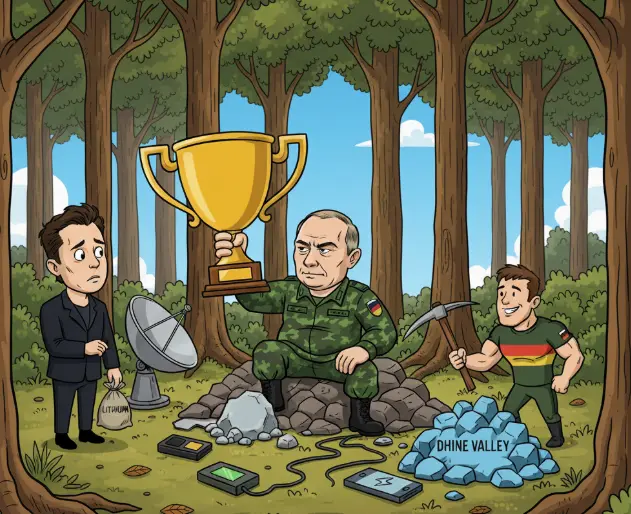
The global race for lithium, the "white gold" of the 21st century, is a high-stakes game of geopolitical chess. For a while, it seemed like Elon Musk and the West were fixated on one prize: the vast, untapped lithium reserves in Ukraine's Donbas region. These deposits were seen as a crucial key to breaking the world's dependency on China for electric vehicle batteries. Then, Russia invaded, and Vladimir Putin effectively seized that prize, adding a valuable economic asset to his bloody conquest. It looked like a strategic masterstroke: control the land, control the future's resources. But while the world was watching the war, Germany quietly made a move that could devalue Putin's entire hand.
Deep beneath the sleepy region of Altmark, the energy company Neptune Energy has confirmed the existence of one of the world's largest lithium deposits. This isn't just another mine; it's a colossal reserve that could potentially supply Europe's entire demand for decades. The discovery changes everything. Putin may be sitting on Donbas's lithium, but he won't be able to hold Europe hostage with it. Germany has just found its own treasure, and it's bigger, cleaner, and right at home. The strategic value of the resources Putin is fighting for has just been dramatically slashed. He may not retreat, but the economic rationale for his brutal campaign is crumbling.
The implications are massive. For years, the West has been nervously watching China's near-monopoly on lithium processing. The fear was that after breaking free from Russian gas, Europe would simply fall into a new dependency on Chinese lithium. This German discovery offers a real path to "strategic autonomy." What's more, the method of extraction is revolutionary. Instead of destructive open-pit mining, the plan is to use Direct Lithium Extraction (DLE) from geothermal brine. This process is not only environmentally cleaner but also generates green energy as a byproduct. It’s a double win for the green transition.
Putin's calculation was simple: conquer Ukraine and sell its resources to a desperate world. He likely imagined a future where the West, including figures like Musk, would have no choice but to come to him, cap in hand, to power their electric car revolution. That future now looks like a fantasy. The Kremlin can hold onto the Donbas, but it can no longer dictate terms on the global lithium market. Europe now has a viable alternative, and it's not in a war zone.
Of course, developing the Altmark deposit will take time and immense investment. But the message is clear: the world is moving on. Putin's war of aggression may have secured him territory, but it has accelerated the West's drive for true independence. He fought a 19th-century war for 21st-century resources, only to discover that his rivals had found an even bigger prize in their own backyard. The Kremlin won't give up its conquered lands, but the German discovery ensures that Putin's lithium victory will be a hollow one, a treasure that lost its sparkle before it was even his to sell.


